Every trading day starts with the same problem: there is simply too much information to filter. You open your charts, check financial news, look at earnings reports, scan market updates, and then jump between different sources trying to figure out what actually matters. Before you know it, you have spent a good part of your morning researching without getting a clear picture.
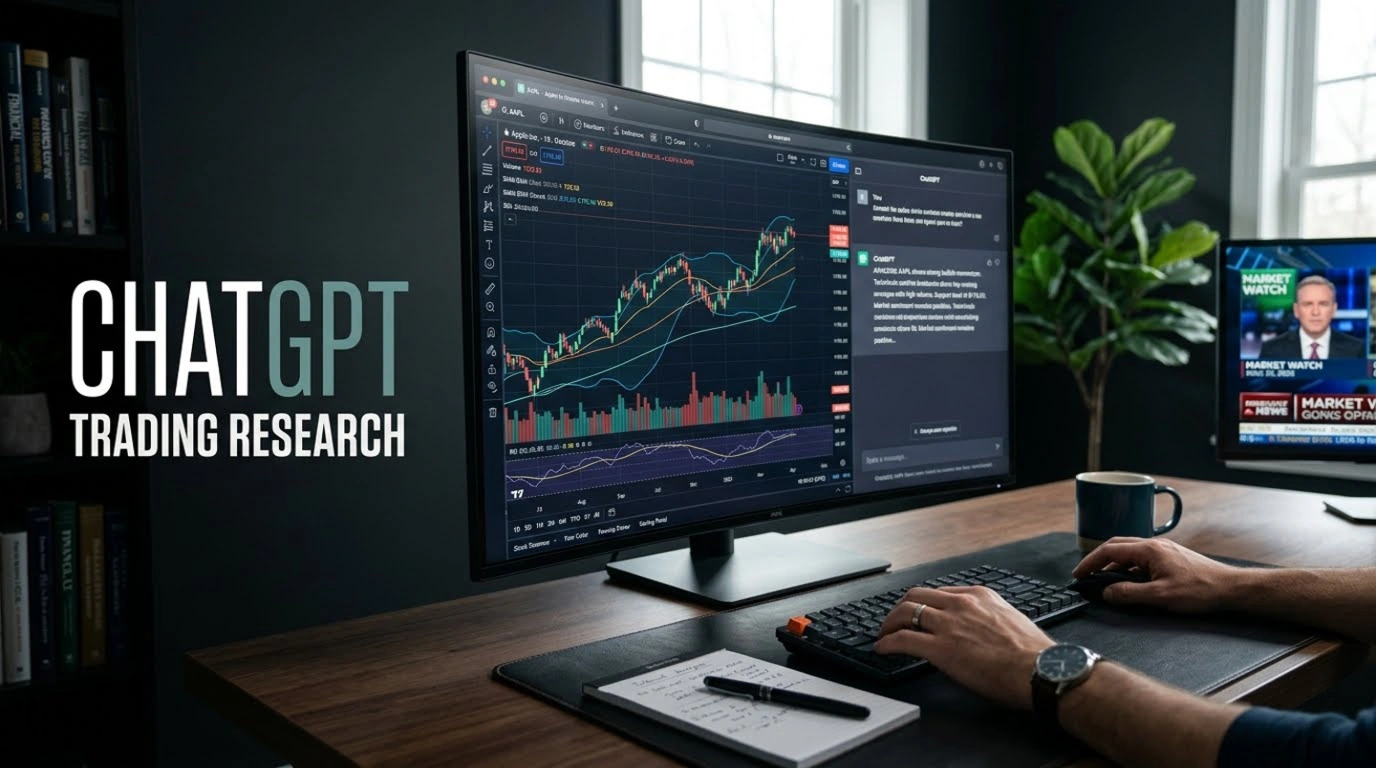
This is where ChatGPT can become useful. It is not a magic money machine, and it cannot predict the market with certainty. Think of it more like a smart assistant sitting beside you while you research. You can give it information, ask it to organize complicated material, explain financial concepts, help you create basic TradingView code, and turn rough trading ideas into clearer rules.
The biggest advantage comes from using ChatGPT to save time on the repetitive parts of research. You still need to verify important information yourself and make your own trading decisions, but AI can make the process much faster and easier to manage.
What Can ChatGPT Actually Do for Traders?
ChatGPT can help with many of the tasks that traders deal with every day. You can use it to summarize long financial articles, break down earnings reports, explain difficult financial terms, organize research notes, generate basic Pine Script, troubleshoot coding errors, and help turn a trading idea into a set of objective rules.
Some practical uses include:
- Summarizing long financial news and earnings reports
- Explaining complicated trading and financial terms
- Creating and modifying basic TradingView Pine Script
- Turning rough trading ideas into testable rules
- Organizing research notes and comparing different pieces of information
- Helping you identify the key points you should investigate further
That doesn’t mean you should ask it, “Which stock should I buy today?” and blindly follow the answer. A better approach is to use ChatGPT to improve your research process. You provide the information and questions, and ChatGPT helps you organize and understand them.
Use ChatGPT to Filter Financial News
One of the easiest ways to use ChatGPT for trading research is to summarize financial news. A long article can contain revenue figures, management comments, industry trends, guidance changes, analyst opinions, and several other details. Reading every line can take a lot of time, especially when you are following several companies at once.
If you have permission to use the text, you can provide the relevant content to ChatGPT and ask it to extract the information most relevant to your research. A useful prompt could be:
Summarize this article into 3 simple bullet points showing what is good or bad for the stock. Then explain which information could have the biggest impact on investor sentiment. Do not predict the stock price.
This type of prompt keeps the focus on information rather than on asking the AI to predict the future. For example, an earnings article might tell you that revenue increased, profit margins declined, management raised full-year guidance, spending increased, and customer growth slowed. ChatGPT can organize those points so you can quickly see which factors look positive and which ones deserve more attention.
You should still go back to the original article or financial filing and verify important numbers. A summary is useful for reducing the amount of information you need to process, but it should not replace the original source.
Turn Earnings Reports Into a Research Checklist
Earnings reports often contain a huge amount of information, and traders can easily focus on one headline number while missing other details that may matter. ChatGPT can help you structure the report around categories that you actually want to investigate.
For example, you can give it this prompt:
Analyze this earnings report for research purposes. Separate the information into revenue, earnings, margins, guidance, customer growth, debt, and management outlook. For each section, identify the main positive and negative points. Use only information contained in the text I provide.
When reviewing the response, pay attention to areas such as:
- Revenue: Is the company growing or slowing down?
- Earnings: Did profit increase or decline?
- Margins: Are margins improving or getting weaker?
- Guidance: Did management raise or lower expectations?
- Customer growth: Are users or customers increasing?
- Debt: Is the company’s debt position changing?
- Outlook: What does management expect going forward?
This can turn a long report into a simple research framework. You might end up with strong revenue growth under one section, weaker margins under another, raised guidance as a positive, and slowing customer growth as a negative.
That is one of the practical advantages of AI in trading research. It doesn’t necessarily give you better information. It can simply help you organize the information you already have.
Ask ChatGPT to Explain Trading Concepts
Trading research often becomes difficult because financial language can get complicated very quickly. You might come across terms such as free cash flow, earnings per share, forward guidance, volatility, price-to-earnings ratios, or different technical indicators and need a simple explanation before you can continue your research.
Instead of searching through several pages, you can ask ChatGPT to explain the term in plain English. For example, you could ask, “Explain free cash flow to me like I’m a beginner, then give me a simple example using fictional numbers.”
You can also keep asking follow-up questions until the concept makes sense. That’s useful for newer traders who don’t want to stop their research every few minutes to look up another financial term.
Use ChatGPT to Generate Pine Script for TradingView
Another practical use is TradingView Pine Script. If you have ever tried coding a custom indicator yourself, you know that even a simple idea can take time when you don’t have much programming experience.
ChatGPT can generate basic Pine Script from a clear description of what you want. For example, you could ask it to create a simple indicator using the 50 EMA and 200 EMA and highlight the points where the two averages cross.
A basic example looks like this:
//@version=6
indicator("50 EMA & 200 EMA Crossover", overlay=true)

ema50 = ta.ema(close, 50)
ema200 = ta.ema(close, 200)

plot(ema50, title="50 EMA")
plot(ema200, title="200 EMA")

bullishCross = ta.crossover(ema50, ema200)
bearishCross = ta.crossunder(ema50, ema200)

plotshape(bullishCross, title="Bullish Cross", location=location.belowbar, style=shape.triangleup, size=size.small)
plotshape(bearishCross, title="Bearish Cross", location=location.abovebar, style=shape.triangledown, size=size.small)
You can put the code into TradingView’s Pine Editor and test it. The useful part is that you can then ask ChatGPT to modify the script. Maybe you want alerts, different moving-average periods, a trend filter, or additional conditions. Instead of coding every change manually, you can describe the change and let ChatGPT generate a revised version.
You can also ask ChatGPT to help with:
- Adding alerts
- Changing indicator periods
- Adding entry or exit conditions
- Displaying signals on the chart
- Adding filters to reduce unwanted signals
- Explaining or fixing coding errors
Still, never assume the code works perfectly just because an AI created it. Always run it in TradingView, check for errors, and make sure the calculations actually match what you intended.
Turn a Trading Idea Into Testable Rules
A lot of traders have ideas that sound good in their heads but are too vague to test. For example, you might think, “I want to trade stocks when the long-term trend is positive and price pulls back before continuing higher.”
That’s a concept, not a complete strategy.
You can ask ChatGPT to turn that idea into objective conditions. A useful prompt would be:
Turn this trading idea into a list of objective rules that could be backtested. Separate the entry conditions, exit conditions, timeframe, indicators, and risk-management assumptions. Do not claim that the strategy is profitable.
Before testing an idea, make sure you define:
- Entry: What exact condition triggers the trade?
- Exit: What tells you to close the position?
- Timeframe: Are you trading on 5-minute, hourly, daily, or another chart?
- Risk: How much are you willing to lose on one trade?
- Position size: How much capital goes into each trade?
- Filters: What conditions must exist before taking the setup?
Now you have something much more concrete. You can test the rules using historical data instead of relying on a vague feeling that the setup “looks good.”
This is a much healthier use of AI than asking it to tell you what trade to take tomorrow.
Where ChatGPT Fails
This is the part traders should take seriously. ChatGPT can make mistakes, misunderstand a question, produce incorrect numbers, or generate code that does not work. Sometimes it can present an incorrect answer in a way that sounds extremely confident.
The biggest problems to watch for include:
- Incorrect financial numbers
- Outdated or incomplete information
- Coding mistakes
- Misunderstanding your trading rules
- Confident-sounding but incorrect explanations
- Poor interpretation of unusual market situations
That matters a lot in financial research because one wrong number can change the way you view a company or strategy.
For example, if you ask ChatGPT for a company’s revenue, debt, earnings, historical price, or guidance figures, verify those numbers using reliable sources. Don’t copy financial data into your research just because the AI gave you a confident answer.
ChatGPT Does Not Automatically Give You a Live Market View
You should also understand the difference between AI assistance and live market data. You should not assume that ChatGPT automatically sees every tick in the market, the current order book, real-time volume changes, or every breaking event happening right now.
The exact information available to ChatGPT can depend on the tools and data connected to the version you are using. For current prices and fast-moving market conditions, use an appropriate live market-data source and verify the information independently.
That becomes especially important in day trading, where market conditions can change quickly.
Never Risk Real Money Without Testing
This is probably the most important rule in the entire article. If ChatGPT gives you a trading strategy, don’t immediately put real money behind it.
Before using a strategy with real capital, you should:
- Define the rules clearly
- Backtest the setup on historical data
- Check the maximum drawdown
- Review losing streaks
- Consider fees and slippage
- Test different market conditions
- Use a large enough sample of trades
A strategy can look fantastic over a small sample and then fail when market conditions change. Even a strong historical backtest does not guarantee future performance.
Use backtesting to learn how an idea behaved historically, not as proof that it will make money in the future.
A Better Way to Use ChatGPT for Trading Research
The best way to think about ChatGPT is as a research assistant, not a crystal ball.
You can start by finding relevant information from reliable sources. Then you can use ChatGPT to summarize that information, explain unfamiliar terms, organize earnings details, and turn rough trading ideas into objective rules. If you have a coding requirement, you can also ask it to create or modify Pine Script.
A simple workflow could look like this:
- Find reliable market information.
- Give the relevant information to ChatGPT.
- Ask it to summarize or organize the key points.
- Verify important facts from the original sources.
- Turn your trading idea into clear rules.
- Backtest the idea before risking real money.
That workflow is much more useful than asking an AI, “Should I buy this stock?” You stay in control of the decision while AI helps you reduce the time spent on repetitive research.
Closing:
ChatGPT can make trading research much faster. It can help you work through long financial articles, organize earnings information, understand unfamiliar concepts, create basic TradingView indicators, and turn ideas into rules that you can actually test.
But don’t confuse convenience with accuracy. ChatGPT can make mistakes, and the market does not care how confident an AI sounds.
Use reliable sources to verify important information, test every strategy before trusting it, and never risk real money just because an AI-generated explanation sounds convincing.
The best use of ChatGPT in trading isn’t asking it to predict tomorrow. It’s using it to become more organized, more efficient, and more disciplined in your research.
Financial Risk Disclaimer: This article is for educational and informational purposes only and does not constitute financial, investment, trading, or other professional advice. Trading and investing involve substantial risk, including the potential loss of money. AI-generated information can contain errors and should not replace independent research or advice from a qualified financial professional. Always verify important financial information from reliable sources and carefully consider your own circumstances before making any financial decision.
Related Articles:
- How To Make Money Using ChatGPT
- 30 Best AI Prompts To Make Money Online
- Best Free AI Tools For Beginners
Free AI Tools

You May Also Like