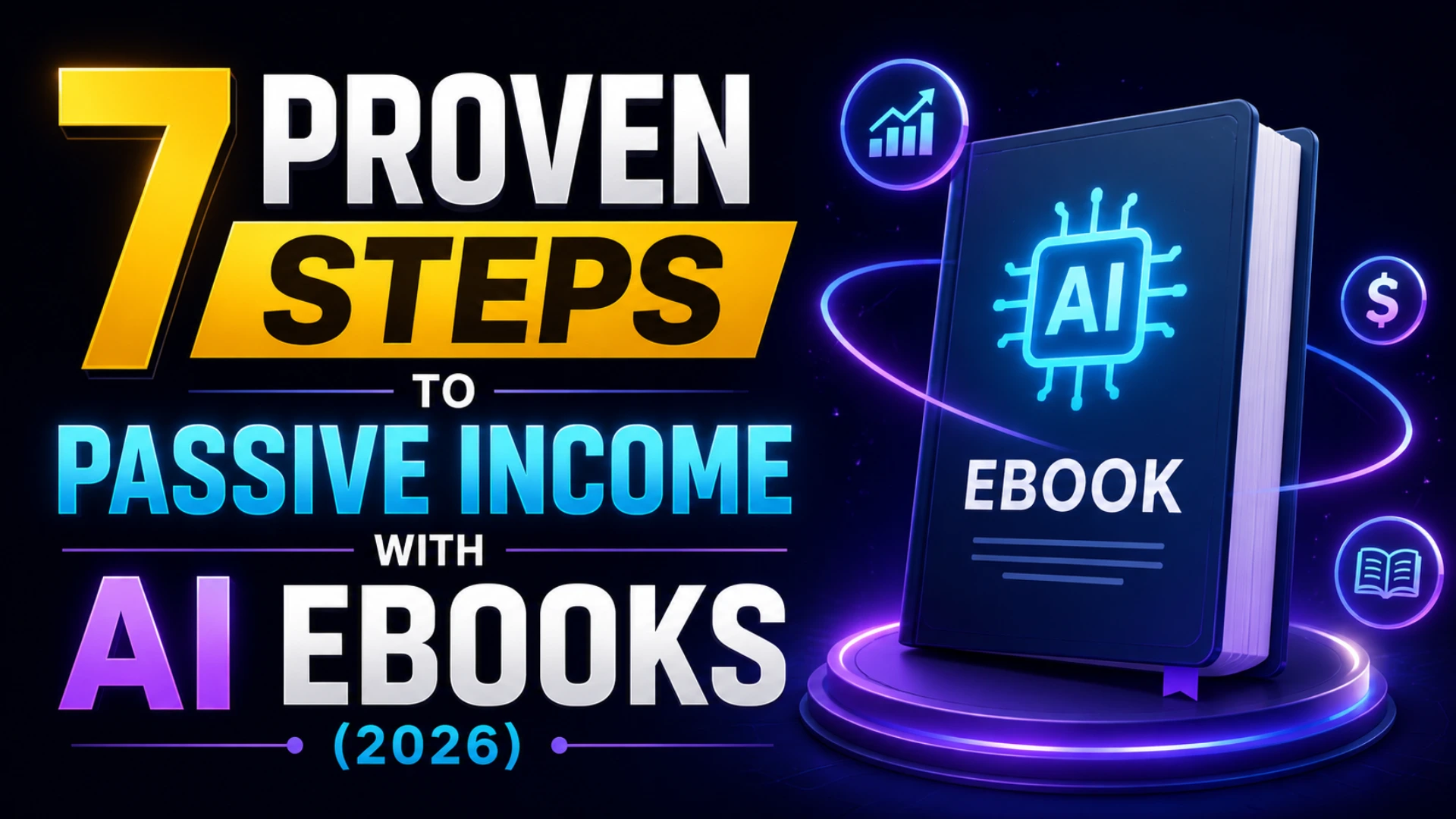
If you’re looking for a real, beginner-friendly way to build passive income with AI ebooks, here’s exactly how it works — no fluff, just the process.
It was 11:47 p.m. on a Tuesday. My phone buzzed. Not a text, not a call — a Gumroad notification. “You made a sale: $19.00.” Then another buzz two minutes later. Then another.
By the time I woke up the next morning, there were six of them. Six people, in six different time zones, had bought a 42-page PDF while I was asleep, dreaming, doing absolutely nothing.
No client calls. No back-and-forth emails. No “let me revise this by Friday.” Just money showing up, because something I’d built once was quietly working without me.
I know how that sounds. It sounds like the opening of every scammy “passive income” ad you’ve learned to scroll past. So let me be blunt about the part those ads always skip: getting to that first $19 sale took real work — a weekend of research, a few evenings of editing, one failed first attempt that sold zero copies.
Why Passive Income with AI Ebooks Is Having a Moment
Ebooks feel like an old idea, which is exactly why most people overlook them. Everyone’s chasing short-form video and courses with cohorts and community calls, and meanwhile this quiet, unglamorous format is sitting there with none of the competition it used to have.
Here’s what actually changed. A few years back, writing a genuinely useful 40-page guide meant weeks of drafting, staring at blank pages, restructuring chapters that didn’t flow.
That time cost was the real barrier — not the idea, not the topic. It was the sheer hours required to turn a good idea into finished pages. AI didn’t remove that step, but it compressed it brutally. What took weeks now takes a few focused days, with AI handling structure and first-draft heavy lifting while you handle the parts that actually require a human — judgment, personal experience, editing.
At the same time, the selling side got just as simple. Platforms like Gumroad and Payhip turned “set up a checkout page” into something you finish in an afternoon, no website, no coding, no merchant account headaches.
Put those two shifts together, and you get a strange gap: real demand for specific, practical guides hasn’t gone anywhere. People still Google “how do I…” a hundred million times a day.
But the cost of producing a good answer to that question, in ebook form, has dropped dramatically. That gap between demand and production cost is exactly where passive income with AI ebooks comes from. It won’t stay this wide forever. Right now, it’s wide open.
Step 1: Picking a Topic People Will Actually Pay For
This is where most first attempts die — not in the writing, in the topic. I’ve watched people spend three weeks polishing a book on a topic nobody was ever going to pay for. I’ve made that mistake myself once too.
A good ebook topic usually has three things going for it, and it needs all three, not just one:
- A specific, narrow problem, not a broad subject. “How to meal prep for a 9-to-5 job on a $50 weekly budget” will outsell “healthy eating” every single time, because the narrow version sounds like it was written specifically for the person reading the title.
- An audience already spending money nearby. If people are already paying for courses, coaches, templates, or subscriptions anywhere near your topic, that’s a signal real money moves through that space — you’re not trying to invent demand from nothing.
- Something you can speak to with genuine authority, even without a fancy résumé. You don’t need ten years of experience. You need a real angle, real research, and the honesty to write only what you actually know or can verify.
Strong starting categories: budgeting for a specific life stage (new parents, first apartment, post-divorce), a structured beginner’s guide to a hobby people get overwhelmed starting, templates for a specific job function, or a step-by-step plan for a goal people already Google constantly — job hunting, a fitness reset, decluttering a home, studying for a specific exam.
One more filter I use: if I can picture the exact person buying it — their situation, what frustrated them enough to search for help — the topic is probably specific enough. If I can only picture a vague crowd, it isn’t.
Step 2: Structuring the Ebook Before You Touch AI
Here’s the part that separates a book that sells from one that gets refunded within a week: structure comes first, AI comes second, always in that order. Before I generate a single word, I sketch out three things on a blank page:
- A working title and a one-sentence promise — what specific transformation does the reader walk away with?
- Between six and ten chapter headings, each one solving exactly one sub-problem, not three
- A rough word count per chapter, usually 800 to 1,500 words — enough to be useful, not so much that it turns into padding
Skipping this step is exactly how you end up with a bloated, repetitive draft that says the same thing four different ways across four chapters. AI will happily fill space if you hand it a vague brief — give it a tight container instead, and it stays focused inside it.
Step 3: Writing With AI Without It Sounding Like AI
Once the outline exists, here’s the actual workflow, step by step:
- Feed the AI one chapter at a time, with the outline point, who the reader is, and the tone you’re going for — never the whole book in a single prompt. One chapter at a time keeps the writing focused instead of generic.
- Ask for a first draft, not a finished one. Mentally treat whatever comes back as clay, not a product. That framing alone changes how carefully you edit it.
- Rewrite the opening and closing lines of every chapter yourself, by hand. This is the single biggest lever for making a book feel human. AI has predictable rhythms at the start and end of sections — breaking that pattern in your own words fixes most of what makes writing feel machine-generated.
- Add one real detail per chapter that AI couldn’t have invented — a specific number from your own research, a tool you actually use, a mistake you actually made. This is what makes a book feel lived-in instead of assembled.
- Read every chapter out loud before finalizing. If a sentence feels clunky to say out loud, it will feel clunky to read silently. This single habit catches more awkward AI phrasing than any editing pass on a screen.
Step 4: Design and Formatting (Simpler Than You Think)
You don’t need a designer, and you definitely don’t need to pay for one on your first attempt. A clean, readable PDF beats a flashy, over-designed one every time — readers are buying the answer inside, not the cover art. The basics that actually matter:
- One consistent font for headings, a separate one for body text — never more than two fonts total
- A simple, clean cover — Canva’s free ebook templates are genuinely good enough to launch with
- Clear chapter breaks and a working, clickable table of contents.
- Export as PDF so it opens identically whether someone’s on a phone, laptop, or tablet.
Spend an afternoon on this, not a week. I’ve seen people burn ten days perfecting a cover for a book they hadn’t finished writing yet — get the content right first.
Step 5: Where to Actually Sell It
Two platforms make the most sense for a first ebook, and both are genuinely beginner-friendly:
- Gumroad — the simplest setup by far, handles payments and file delivery automatically, and you don’t need a website to launch
- Payhip — very similar to Gumroad, with slightly better options once you want to bundle multiple products together later
Both let you build a product page, upload your PDF, and start selling within an hour of deciding to. You don’t need a blog, an email list, or a big social following to launch — though having any one of those will noticeably speed up your first sales.
Step 6: Pricing and Getting Your First Sales
Most beginner ebooks in a specific, well-chosen niche sell well between $9 and $27. Underpricing it — dropping to $2 or $3 because it feels safer — doesn’t actually get you more sales. It just signals low value, and ironically tends to attract the buyers most likely to ask for a refund.
For your first handful of sales:
- Share it directly inside relevant online communities where the topic is genuinely being discussed — as a real, useful answer to a real question people are already asking, never as drive-by spam.
- Offer it to your existing network first, even if that’s a small handful of people you know personally.
- If you already have any blog, newsletter, or social presence, link it naturally wherever it actually fits the content.
Step 7: Making It Actually Passive Long-Term
“Passive” doesn’t mean “built once, never touched again.” A little quiet maintenance keeps a book selling for years instead of weeks:
- Revisit the content every few months and update anything that’s gone stale — tool names, prices, screenshots.
- Refresh the cover design occasionally; a tired-looking cover quietly kills conversions over time.
- Keep sharing it in new relevant conversations as they come up, rather than treating the launch as a one-time event.
None of this takes more than an hour or two a month once the book is live — but skipping it entirely is how a good ebook slowly stops selling without you ever noticing why.
Mistakes That Kill Ebook Sales
- Making the topic too broad. “Everything about productivity” sells worse than “a 2-week system for clearing your inbox for good,” every time, without exception.
- Skipping the outline and letting AI ramble. Unfocused, repetitive chapters are the fastest route to a refund request.
- Zero personal touch anywhere in the book. A guide that reads like it could’ve been written about anyone, for anyone, rarely feels worth paying for.
- No clear promise on the sales page. If a stranger can’t tell what they’ll get in one sentence, they won’t click buy — no matter how good the book actually is.
FAQs
Do I need to be an expert to write an ebook on a topic? No — you need a genuinely useful, well-researched angle. Many successful niche ebooks are written by people who solved one specific problem for themselves and documented the process clearly enough for someone else to follow.
How long should a first ebook be? Most successful beginner ebooks run 30 to 60 pages. Longer isn’t better here — focused and genuinely useful beats long and padded, every time.
Can I really use AI for the whole thing? You can lean on it heavily for drafting, but the editing, the personal examples, and the final structure need to be yours. Books that are pure AI output with no human editing tend to feel hollow, and readers notice that faster than you’d expect.
How much does it cost to get started? Realistically, close to $0. Canva’s free plan covers the design side completely, and Gumroad doesn’t charge anything upfront — it just takes a small percentage per sale instead.
Is this actually passive once it’s live? Mostly, yes — but it still needs occasional attention: updating outdated details, refreshing the cover now and then, and continuing to share it where relevant. “Passive” means low-maintenance, not zero-maintenance forever.
Final Thoughts
The gap between “I have an idea for an ebook” and “I have a finished, sellable ebook” used to be measured in months. Right now, in 2026, it’s realistically measured in days — as long as you approach it with a clear structure and treat AI as a drafting partner rather than a magic button that thinks for you.
Start narrow. Start small. Your first ebook doesn’t need to be perfect, and it doesn’t need to be long. It needs to solve one specific problem clearly enough that a stranger, at 11 p.m., decides it’s worth $19 to skip the trial and error themselves.
If you’re also exploring other ways to earn with AI tools, my guide on making money with ChatGPT pairs well with everything covered here — the two approaches work side by side nicely.
For more information, Watch This Helpful Video:

You May Also Like


2 thoughts on “7 Proven Steps to Passive Income with AI Ebooks (2026)”