

If you have been following the latest AI models, you have probably heard about Claude Opus 5.5. Anthropic’s newest Opus model is designed to handle complex tasks such as coding, writing, research, and other demanding work.
But how good is Claude Opus 5.5 in real-world use? In this article, I’ll look at its benchmarks, pricing, and real-world performance to see what it can actually do. I’ll also cover how it compares on important tasks and whether its performance is worth the cost. So, let’s start.
Why Claude Opus 5.5 was Introduced?
Anthropic introduced Claude Opus 5.5 to make its AI better at handling the kind of difficult tasks people actually work on. The focus is not just on giving quick answers, but on things like coding, research, computer use, and tasks that take several steps to complete. With this model, Anthropic is trying to make Claude more useful for bigger and more demanding projects.
Claude Opus 5.5 Benchmarks results
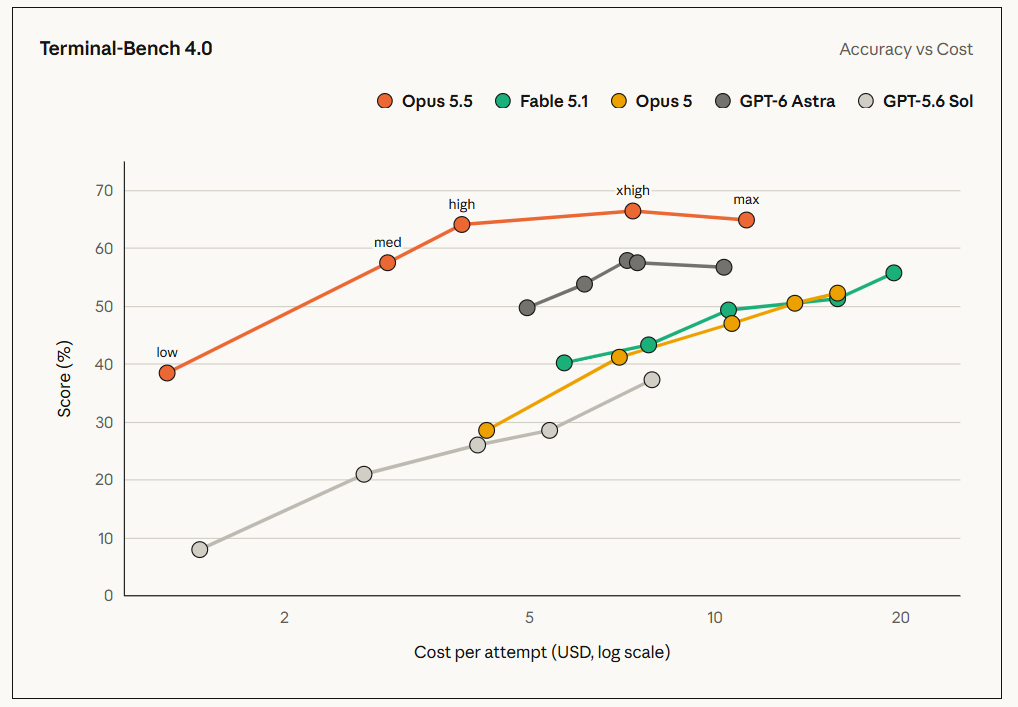
Claude Opus 5.5 shows strong results across several major benchmarks. On Terminal-Bench 4.0, it scored 66.4%, compared with 57.9% for GPT-6 Astra and 55.8% for Claude Fable 5.1. It also reached 54.4% on Frontier Code v1.1 and 57.8% on Cursor Bench 4.0, showing solid performance in agentic coding tasks.
The model also performed well on knowledge-work and reasoning tests. On GDP Val-AA v2.1, which evaluates real-world professional tasks, Claude Opus 5.5 scored 1846 Elo. It reached 67.7% with tools on Humanity’s Last Exam and 81.8% on OS World 2.0 for computer-use tasks. However, results varied across benchmarks, so these scores should be viewed as individual measures rather than a complete picture of real-world performance.
Claude Opus 5.5 Pricing
Claude Opus 5.5 is priced at $4 per million input tokens and $20 per million output tokens on the standard API. Anthropic also charges $0.20 per million tokens for cache reads, which can help reduce costs for repeated or longer tasks. These rates are lower than the previous Opus 5 pricing.
The Claude Opus 5.5 API pricing is also designed around better cost efficiency. Anthropic says the model costs about 40% less to run than Opus 5 on typical workloads, while generating output more than 30% faster. There is also a faster mode available at $8 per million input tokens and $40 per million output tokens.
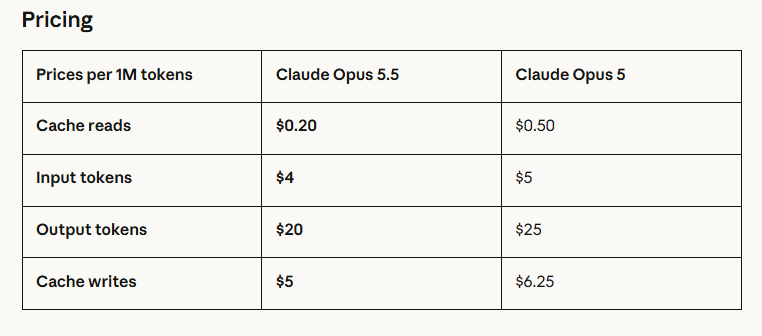
Official pricing information for Claude Opus 5.5, including input and output token costs.
Claude Opus 5.5 Real-World Performance
One interesting example of Claude Opus 5.5’s real-world performance is its ability to handle large software projects. In one test, an early user gave it a 200,000-line codebase to audit and fix. The model completed the work in less than three hours, while the previous Opus 5 took more than 20 hours and used about 2.5 times more tokens.
Claude Opus 5.5 also showed useful results in research and professional tasks. Anthropic tested it on reports, financial analysis, and other knowledge-work tasks, where the model was able to gather information, work with data, and produce structured results. These examples show how the model can be useful beyond simple questions and short AI-generated answers.
Benefits Of Opus 5.5
Claude Opus 5.5 has some useful features that make it a good fit for people who need more from an AI model. Instead of focusing only on quick answers, it can help with bigger tasks that require more time, information, and attention. Here are some of the main areas where it can be useful.
Professional Coding
Claude Opus 5.5 can help developers working on large or complex coding projects. It can help write code, find bugs, understand existing code, and work through problems step by step. This is especially helpful when a project has many files or requires changes across different parts of the code.
Advanced Research
Research is another area where Claude Opus 5.5 can be useful. It can work through large amounts of information, organize details, and help users understand complicated topics. This makes it useful for tasks such as preparing reports, comparing information, or finding patterns in a large amount of text.
Complex Tasks
Some tasks cannot be completed with a single simple prompt. Claude Opus 5.5 is designed to handle longer workflows where several steps need to be completed in order. It can follow detailed instructions and work through different parts of a task, which can be helpful for projects that need more planning and reasoning.
Claude Opus 5.5 vs GPT 5.5
| Feature | Claude Opus 5.5 | GPT-5.5 |
|---|---|---|
| Main Focus | Coding, agentic work, research, complex tasks | Coding, research, professional work, computer use |
| API Input | $4 / 1M tokens | $5 / 1M tokens |
| API Output | $20 / 1M tokens | $30 / 1M tokens |
| Context Window | 1M tokens | 1.05M tokens |
| Computer Use | Supported | Supported |
| Web Search | Available through Claude tools | Supported |
| Coding | Strong performance on agentic coding | Strong performance on agentic coding |
| Reasoning | Designed for complex, multi-step work | Designed for complex professional work |
Is Opus 5.5 Worth It?
Claude Opus 5.5 can be worth it if you need an AI model for serious and demanding work. It is more useful when you are dealing with coding, research, large projects, or tasks that need several steps to complete. If you only use AI for simple questions or basic writing, you may not need this level of performance. The pricing is also worth considering, especially for developers using the API regularly. With its combination of strong performance, useful tools, and improved efficiency, Opus 5.5 can be a practical choice for heavier AI workloads. The real value depends on how often you use it and what kind of work you need it to handle.
FAQS
How does Opus 5.5 compare with Opus 5?
Claude Opus 5.5 improves on Opus 5 in several areas, while also being more efficient. Anthropic says it uses fewer tokens per task and costs about 40% less on typical token-billed workloads. Its standard API price is $4 per million input tokens and $20 per million output tokens, compared with $5 and $25 for Opus 5.
Can you use Opus 5.5 with Claude Code?
Yes. Claude Opus 5.5 is available in Claude Code, and Anthropic also offers a Fast mode for Opus 5.5 that can provide up to 2.5× faster speed.
How much does Opus 5.5 cost?
Claude Opus 5.5 costs $4 per million input tokens and $20 per million output tokens on the standard API. Cache reads cost $0.20 per million tokens. Anthropic also offers a Fast mode at $8 per million input tokens and $40 per million output tokens.
What can Claude 5.5 do?
Claude Opus 5.5 can handle advanced coding, agentic tasks, research, and other complex workflows. Anthropic highlights its ability to work on large codebases, debug and refactor code, coordinate multi-step tasks, and work with computer-use workflows.
How large is the context window of Opus 5.5?
Claude Opus 5.5 supports a large context window designed for working with lengthy information and complex tasks. This makes it possible to provide more code, documents, or other information within a single workflow instead of breaking everything into small parts.
Conclusion
After looking at the benchmarks, pricing, and real-world performance, Claude Opus 5.5 clearly brings some meaningful improvements over previous versions. Its benchmark results are impressive, while the lower pricing and better efficiency make the model more practical than before. The real-world results also show that its performance is not limited to benchmark scores and can translate into useful results on demanding tasks.
Overall, Claude Opus 5.5 feels like a solid step forward for Anthropic, with a better balance between performance, speed, and cost. Whether you use Claude regularly or are simply following the latest AI models, Opus 5.5 is definitely an update worth paying attention to.

You May Also Like