
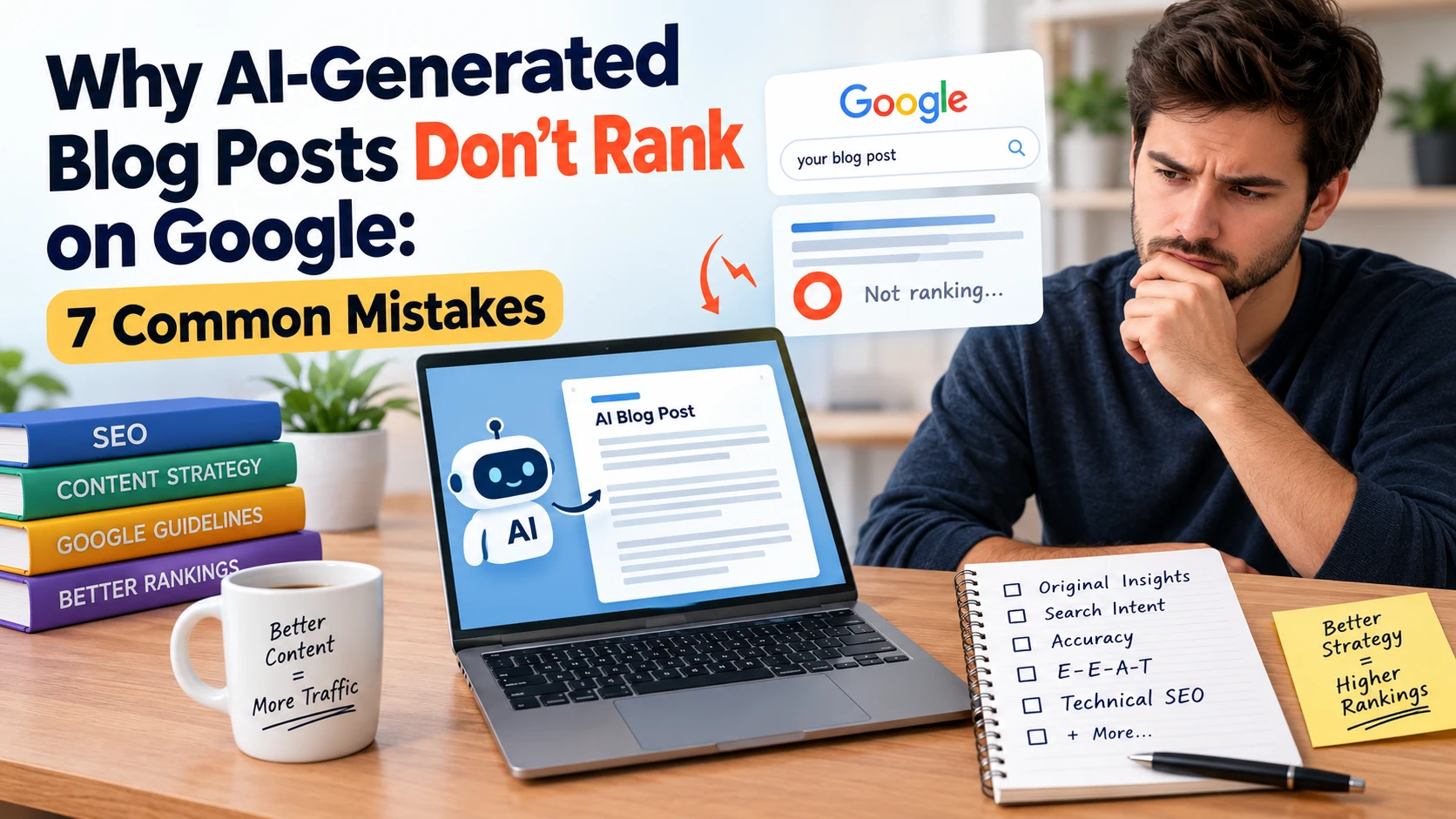
You publish a 1,500-word post that took twenty minutes to produce. A few weeks later, Search Console shows a trickle of impressions and almost no clicks. So you publish ten more, and the pattern repeats and your AI blog posts don’t rank on Google.
One of the most common frustrations among bloggers who use AI tools. The surprising part is that the problem usually isn’t that a machine wrote the first draft. It’s what surrounds the draft.
In this guide, you’ll learn what Google has actually said about AI-generated content, the seven mistakes that most often hold AI-assisted articles back, and a checklist you can use on your very next post. You’ll also get a direct answer to a question that worries many site owners: does Google penalize AI-generated blog posts?
Why AI-Generated Content Doesn’t Rank: Understanding the Real Problem
Start with what Google has said. Its published guidance explains that AI-generated content isn’t banned, because Google’s systems are designed to reward helpful content. In other words, AI gets no bonus and no automatic penalty. It’s simply content, and it competes like any other content.
That’s why AI-generated content doesn’t rank when it’s built from a one-line prompt and published as-is. A model asked to “write a blog post about X” tends to summarize what’s already on the web. If dozens of pages already say the same thing, there’s little reason for Google to show yours.
The Google guidelines for AI-generated content come down to two threads. Creators are told to focus on accuracy, quality, and relevance, especially when content is generated automatically. And using AI tools especially ( Chatgpt ) to produce many pages without adding value for users may violate Google’s spam policy on scaled content abuse. Both threads come up repeatedly below.
Why Is My AI Content Not Ranking on Google? A Quick Diagnosis
Before you rewrite anything, work out which situation you’re in:
- The page isn’t indexed. In Search Console’s indexing report, a status like “Crawled – currently not indexed” means Google has seen the page but hasn’t added it. That’s a different problem from ranking poorly.
- The page is indexed but buried. This points to a quality, intent, or authority problem, which is what the seven mistakes below address.
- The page ranks, but nobody clicks. Your title and description may not match what the searcher expects.
- The page is brand new. New pages and new sites often need time to be discovered and evaluated, so judge progress over weeks, not days.
Most cases of AI content not ranking on Google fall into the second group, and they trace back to one or more of the mistakes that follow.
Mistake 1 — Publishing Generic AI Content Without Original Insights
Generic content is the most common weakness of un-edited AI drafts. The text is grammatical and well organized, but it could appear on any site, because it only recombines widely available information. Sameness is a common reason for AI content not ranking on Google: if your post adds nothing the existing results lack, a searcher has no reason to prefer it.
How to make AI blog posts more helpful for SEO starts with one question: what does this page offer that the current top results don’t? Try this quick check:
- Open the top five results for your target query.
- List the main points each one covers.
- Decide what you can add: first-hand experience, original data, a worked example, a clearer explanation, or a stronger, well-supported opinion.
- Give those specifics to the AI in your prompt, or add them after the draft.
Say you’re writing about setting up a home office. A generic draft lists “get an ergonomic chair” and “improve lighting.” A useful version includes your own setup, the mistakes you made, what you’d change, and what it cost. If you run a business, add real customer questions, your actual process, and screenshots.
Use only experiences that are genuinely yours.
Mistake 2 — Targeting the Wrong Search Intent
Every search has a reason behind it. Someone searching “best CRM for small business” wants a comparison to help them choose. If your AI-written post is a definition of what a CRM is, it may be well written and still answer the wrong question.
Search intent mismatch is a quiet driver behind AI content not ranking on Google, because a polished page that doesn’t match the query tends to lose to one that does. Intent generally falls into four buckets:
- Informational: the searcher wants to learn something.
- Commercial investigation: the searcher is comparing options.
- Transactional: the searcher is ready to buy or sign up.
- Navigational: the searcher wants a specific site or page.
To get it right:
- Search your target keyword and note what actually ranks: how-to guides, listicles, product pages, videos, tools.
- Read the “People also ask” questions and look for patterns in what the top results cover first.
- Answer the main question near the top, then add depth below.
- Match the dominant format unless you have a strong reason to differ.
AI tools can’t see live search results unless you provide that context, so tell the model the intent, the reader, and the format you want.
Mistake 3 — Overusing Keywords and Producing Awkward Writing
Tell an AI tool to “include the keyword 15 times” and it will, whether or not it reads well. The result is stiff, repetitive paragraphs. Keyword stuffing is one of the most visible AI-generated content SEO mistakes, and it’s also a practice that Google’s spam policies call out. Even when the topic is right, stuffed, robotic prose can leave AI content not ranking on Google, because it’s tiring to read and hard to trust.
Other common tells include:
- Filler openings like “In today’s fast-paced digital world.”
- A summary paragraph repeating the point at the end of every section.
- Vague transitions and obvious tips that say nothing specific.
How to fix it:
- Focus each page on one main topic and let related terms appear naturally. There’s no magic keyword density to hit.
- Read the draft aloud and rewrite anything you wouldn’t say to another person.
- Replace vague claims with specific ones.
- Prompt for style: “Write in plain, direct American English. Mention the main topic only where it fits naturally. Skip clichéd openings.”
Mistake 4 — Publishing Inaccurate or Unverified AI-Generated Information
AI tools can state wrong things with total confidence: invented statistics, studies that don’t exist, outdated advice, misattributed quotes, broken links. Publishing them erodes reader trust, and trust is hard to rebuild.
Google’s guidance puts accuracy first, as noted earlier. One industry report says that on October 1, 2026, Google updated its generative AI guidance to call manual fact-checking and review of all AI-generated content critical before publishing, including titles, meta descriptions, structured data, and image alt text. Because that comes from a secondary source, read Google’s guidance page yourself before citing it. Either way, the practice is sound.
A simple verification workflow:
- Highlight every number, date, name, quote, and factual claim.
- Trace each one to a primary source, such as official sites, original studies, or product documentation.
- Delete anything you can’t verify. “Probably true” shouldn’t make it to publication.
- Check for outdated information: prices, laws, software features, version numbers.
- Open every link to confirm it works and says what you claim.
- Add a “last updated” date when you revise a post.
Take extra care with health, money, and legal topics. Google’s rater guidelines apply a higher standard to them, and an expert review is worth the effort. Those ratings don’t directly influence ranking, but they show the bar Google’s systems are trying to meet.
Mistake 5 — Ignoring Experience, Expertise, Authoritativeness, and Trust
Google’s guidance for people using AI to create content is to focus on E-E-A-T: experience, expertise, authoritativeness, and trust. Here’s what each means in practice:
- Experience: you’ve actually used the product, lived the situation, or done the work.
- Expertise: you or your reviewers know the subject well.
- Authoritativeness: others recognize you or your site as a reliable source.
- Trust: the content is accurate, transparent about who made it, and safe to rely on.
AI can’t supply experience. It hasn’t tested the software or tried the recipe. That part has to come from you.
Google also suggests evaluating content by asking Who created it, How it was created, and Why. That framework applies whether or not AI is used. Putting it into practice:
- Add a real author byline with a short bio and relevant credentials. Google says listing AI as the author is probably not the best way to be transparent about AI use.
- Where it helps readers explain how automation was used in creating the content.
- Publish clear About, Contact, and editorial standards pages, and cite your sources.
- Have a subject-matter expert review posts on specialized topics.
Mistake 6 — Publishing Too Many AI Articles Without a Clear Content Strategy
AI makes volume cheap, which makes it tempting to publish fifty posts in a week. But volume without purpose carries real risk. Google introduced “scaled content abuse” in March 2024, rewriting its earlier policy on spammy auto-generated content. Analysts note the policy focuses on purpose rather than the tool or the number of pages: many pages created mainly to manipulate rankings instead of helping readers, regardless of whether AI, automation, or people produced them.
Publishing hundreds of lightly edited drafts is how a site ends up with AI content not ranking on Google across the board. A better approach:
- Choose a focused set of topics where you can genuinely help readers.
- Plan a main guide plus supporting posts that link to each other.
- Give every post a distinct purpose, so no two compete for the same query.
- Publish at a pace you can actually fact-check and edit.
How to Fix Thin AI-Generated Blog Content
If you already have a pile of thin posts, audit them one by one and choose an action:
- Improve: add original insight, real examples, better structure, and verified facts.
- Merge: combine overlapping posts into one stronger page and 301-redirect the old URLs to it.
- Remove: delete or no index posts that have no clear purpose and can’t be salvaged.
Use Search Console to prioritize. Start with pages that already earn impressions, since they’re closest to paying off.
Mistake 7 — Ignoring Technical SEO and Failing to Measure Results
Strong content still has to be found, crawled, and understood. If you’re troubleshooting AI content not ranking on Google, check these basics before rewriting entire posts, because no amount of editing helps a page Google can’t index.
- Indexing: review the Pages report and submit an XML sitemap.
- Internal links: link each new post from related pages using descriptive anchor text. Orphan pages are harder for crawlers to discover.
- Titles and meta descriptions: make them unique and accurate. AI-written ones tend to be generic.
- Page experience: make sure pages load quickly, work on mobile, and are easy to read.
- Structured data: use only markup that matches what’s visible on the page, and validate it.
- Cannibalization: merge or differentiate posts that target the same query.
Then measure. In Search Console’s Performance report, watch impressions, clicks, click-through rate, and average position:
- High impressions, low CTR: rewrite the title and description to better match intent.
- Average position around 8–20: deepen the content and add internal links.
- No impressions: check indexing first.
Give changes time to show up before judging them, and change one thing at a time so you know what worked.
How to Improve AI-Generated Content for SEO: A Practical Checklist
Use this checklist whenever you’re fixing AI content not ranking on Google or preparing a new post.
Before you write
- Define the search intent and the specific reader.
- Gather your own material: notes, data, examples, screenshots, and expert input.
- Pick one main topic for the page, and check it doesn’t overlap an existing post.
How to optimize AI-written articles for Google while drafting and editing
- Give the AI specifics: audience, intent, outline, your material, and tone.
- Edit heavily. Restructure, cut filler, and add examples only you could provide.
- Answer the main question early, then expand.
- Use descriptive H2 and H3 headings, short paragraphs, and lists where they help.
- Run a final scan against the AI-generated content SEO mistakes covered above.
Before you publish
- Fact-check every claim and open every link.
- Add an author byline and bio, and a note on how AI was used if it helps readers.
- Manually review the title, meta description, image alt text, and any structured data.
- Add internal links to and from related posts.
After you publish
- Confirm the page is indexed.
- Track performance in Search Console and refresh posts that stall.
A starter prompt you can adapt:
“Draft a post for [audience] about [topic] that answers [main question] in the first section. Use only the facts and examples I provide below. If you need a statistic or source, mark it ‘needs verification’ instead of inventing one. Write in plain, direct American English. [Paste your notes and examples.]”
You can also check our Famous Claude prompts for Content Writting & Also learn How to get more visitors on your blog post
Does Google Penalize AI-Generated Blog Posts?
The short answer: not for using AI. Reports on Google’s guidance note that AI-generated content isn’t a violation of its search guidelines, but using automation including AI primarily to manipulate rankings is a spam policy violation. The Google guidelines for AI-generated content don’t ask whether a person or a model typed the words. They ask whether the page helps people.
It helps to separate two ideas. Google can respond to spam-policy violations with automated demotion or a manual action, and a manual action would appear in the Manual Actions report in Search Console. But seeing AI content not ranking on Google doesn’t mean you’ve been penalized. Far more often, weaker pages simply lose to better ones.
So rather than hunting for ways to make text “undetectable,” put your energy into originality, accuracy, and real usefulness. No process can guarantee a ranking, but these are the factors you control.
Conclusion
The seven mistakes share a common thread: AI is good at drafting and poor at judgment. Generic content, wrong intent, stuffed keywords, unverified facts, missing trust signals, unfocused publishing, and neglected technical basics all come from treating a draft as a finished product.
How to improve AI-generated content for SEO ultimately comes down to adding what AI can’t: your experience, your verification, and your strategy.
If you’re staring at AI content not ranking on Google today, don’t delete everything. Pick your three most promising posts this week, run each through the checklist above, and track what changes in Search Console over the following weeks. Then repeat with the next batch.

You May Also Like